
As I sat and reread some of my recent blogs, it occurred to me that I needed to add a few more thoughts. I used to be a teacher who ranted and raved and punished. Students would report that they were afraid of me....I had a very strong need to power over my students....I was really bothered by the fear I caused in present students, past students and future students. Was that really what I wanted? The answer was NO. I didn't want students to do what I wanted because they were afraid, I wanted them to do what I wanted them to do because they wanted to learn. I didn't want to be that teacher anymore. I needed to change. That is one of the main reasons I have chosen Choice Theory. It gave me the opportunity to focus on my power within and my power from rather than my need to power over. I know that trying to control students is nearly impossible, from my work with choice theory I now know that it is totally impossible since the only person I can control is myself. Yes, you can get compliance through fear, intimidation, and punishment but that was not what I wanted.
The second main reason for using choice theory and a competence based classroom come from my high need for power within. That is the power I get when I'm successful as a teacher. I had always had success as a teacher, or so I thought until we began to give a pre and post test in science that was designed to test student learning of the concepts taught throughout the year. The first year, my students average score on the post test was 40%...pretty sad results, yet the majority of those same students had achieved A's, B's or C's. These results caused me to do some soul searching and evaluating of what I taught and how I taught it. The next year saw some changes and again, the post test results were painful to look at. I could have said it wasn't me, it was the test, but I helped write the test, so that would be just like saying it was me. I decided that something really had to change. I became a part of our Academy and took classes on Action Research and Understanding By Design. I rewrote two of my units and presented my students with more choices, more technology, more real life learning and less worksheets and tests. Obviously my hope was that my post test scores would improve. I also shared with the students what they needed to know and understand in each of the units. I told them that it was my goal to have each and everyone achieve 80% or better on the post test. Believe it or not, they did it. Even those students who didn't complete the day to day work go 80%. I was thrilled. I also knew that there was more work to be done. I continued to rework my units and participate in the Academy. The focus the second year was on leadership and action research that collected "hard" data for evaluation. Again I relied on the pre/post test we had been using. I wasn't quite as successful the second year, however all of my students achieved 75% or better. Throughout this time, I was still very much a traditional teacher in that I expected and even demanded that students do what I wanted when I wanted it. I tried to control not only their learning, but also their behavior.
It was during my third year as an Academy participant that Dale introduced us to Bob Sullo's Activating the Desire to Learn. That really was the turning point for me. I tried the idea of a competence based classroom for one unit towards the spring of the year. I also worked on giving up some of my control issues. Scantron, standardized testing, was used for the first time that year rather than the pre/post test we had developed. I was hopeful that my students scores would improve, but I had my reservations. The focus of my Academy work for that year was again centered around improving my teaching to meet the needs of all the students and improve the overall learning. Again, my students showed growth which was really good, however, I knew that more changes were necessary. It wasn't necessarily the content or the delivery that had to change, it was me personally. I was still frustrated by students lack of interest in school, their doing the work only if it was "for a grade" and their lack of enthusiasm for learning.
That lead me to Basic Intensive Week, which I believe has made me a better teacher. I haven't raised my voice or "gone off" on a student yet this year, which I think is really good. My students seem to be having fun learning and are retaining more information than ever. I won't know how well they do on the scantron test until late in May, but in class discussions I see more students involved and sharing what they have learned than ever before. They seem to want to learn and do well not for the grade, but because they want to learn. Friday, during my science class we discovered that we were double booked in the computer lab. I decided to take my students back to my classroom and let them work on the Mac's. One group of students asked as we were going back if we could have circle time. I said sure, what would you like to talk about. Their answer was our recent trip to the Body Worlds Exhibit at the museum. They were so excited...the discussion that followed was amazing. We talked about what they saw, learned and questions they had. What was really amazing was as the bell rang, they asked if they could come in at lunch and continue the discussion....never in 27 years of teaching had that ever happened. That for me was the icing on the cake. They were excited about learning, they were sharing and they were having fun doing it. Isn't that what education is all about.....
Friday, April 4, 2008

Thursday, March 20, 2008
My Grey World
I have a student who really understands choice theory. In fact I believe he gets it better than most. He is bright, and totally unmotivated to do school work. His main goal seems to be to set the adults in his world off and engage them in a power struggle. He get his power need, freedom need and fun need met every time he succeeds.
This student was assigned to my advisory class at the end of last year and he is also in my science class. He is challenging some days, but over the course of the year, we have developed a pretty good relationship. Some of his teachers can only see the bad in him. They see the world as black and white and this particular child has no good in him in their opinion. I on the other hand love to see the shades of grey that make life so very interesting.
Today is our potluck lunch. Each child was asked to bring in something to contribute to the lunch. This student chose tomatoes. Before school started he came into my room with his hands behind his back and said "Ms. L are you going to be mad at me if I forgot tomatoes, but brought something else.?" I replied "No, I won't be upset. What did you bring?" With a huge smile on his face he brought his hands out from behind his back producing a bag of tomatoes.....I almost fooled you didn't I? I had to laugh and at the same time I thought about how sad it was that some never would see this fun playful side of him because they only saw a naughty boy.
Am I in his quality world? I don't know. I do know that he is always respectful and polite to me. He rarely tries to cross the line and when he does he knows that I will talk to him about the choice he made and why. I don't rant and rave or punish him. Does he do my classwork. Yes and No. He rarely turns in any written work, but always demonstrates his understanding verbally. Is he succeeding......Is he learning.....
This student was assigned to my advisory class at the end of last year and he is also in my science class. He is challenging some days, but over the course of the year, we have developed a pretty good relationship. Some of his teachers can only see the bad in him. They see the world as black and white and this particular child has no good in him in their opinion. I on the other hand love to see the shades of grey that make life so very interesting.
Today is our potluck lunch. Each child was asked to bring in something to contribute to the lunch. This student chose tomatoes. Before school started he came into my room with his hands behind his back and said "Ms. L are you going to be mad at me if I forgot tomatoes, but brought something else.?" I replied "No, I won't be upset. What did you bring?" With a huge smile on his face he brought his hands out from behind his back producing a bag of tomatoes.....I almost fooled you didn't I? I had to laugh and at the same time I thought about how sad it was that some never would see this fun playful side of him because they only saw a naughty boy.
Am I in his quality world? I don't know. I do know that he is always respectful and polite to me. He rarely tries to cross the line and when he does he knows that I will talk to him about the choice he made and why. I don't rant and rave or punish him. Does he do my classwork. Yes and No. He rarely turns in any written work, but always demonstrates his understanding verbally. Is he succeeding......Is he learning.....
Wednesday, March 12, 2008
Ponderings
I'm glad I have the opportunity to continue to learn and grow as a professional educator. If I hadn't believed that I could succeed at college, I wouldn't be here now....I would be working at a grocery store for slightly more than minimum wage. I believe that we need to move away from the once and done belief that permeates our educational system. This may be radical talk, but students won't take responsibility for their learning if we continue to give them excuses such as I've never been good at science so therefore I'm not going to do well now. Another favorite is I didn't understand any of it, its just too hard. Truth of the matter is that these students didn't do well in the once and done classroom. They didn't meet with success, so they have taken science out of their quality world. Had they been in a CBC classroom, they just might enjoy science and be really good at it. I believe that there is hope for everyone and by allowing them to meet with success no matter how much time it takes, we will encourage students rather than discourage students.
I know this removes all competition within a classroom. Isn't it better to be competitive with yourself than to have to be the "top dog" in a class. What does the top dog do when they hit the top? What is the motivation to go further? In my classroom, I've tried to create a win win situation for all the students. I challenge students to think beyond what I've said. I know some competition is good, but when does it become too much?
It is really hard for me to set the top limit in my classes. I want students to know that there isn't one correct answer or one correct way to get there. If they can demonstrate their understanding, explain their thought process, be guided if they don't understand, and explore their thinking isn't that better than remembering bits and pieces of information for a test and then quickly forgetting them?
We have officially started the final trimester of the school year. I still have four students who do not have grades from first trimester. I have added a few more students who don't have grades for the second trimester. I have spent time with each one of these students asking them the following three questions: Do you know what you need to do?, Do you know how to do it?, and Do you want to do it? Interestingly all of them said they knew what to do and they all knew how to do it
I know this removes all competition within a classroom. Isn't it better to be competitive with yourself than to have to be the "top dog" in a class. What does the top dog do when they hit the top? What is the motivation to go further? In my classroom, I've tried to create a win win situation for all the students. I challenge students to think beyond what I've said. I know some competition is good, but when does it become too much?
It is really hard for me to set the top limit in my classes. I want students to know that there isn't one correct answer or one correct way to get there. If they can demonstrate their understanding, explain their thought process, be guided if they don't understand, and explore their thinking isn't that better than remembering bits and pieces of information for a test and then quickly forgetting them?
We have officially started the final trimester of the school year. I still have four students who do not have grades from first trimester. I have added a few more students who don't have grades for the second trimester. I have spent time with each one of these students asking them the following three questions: Do you know what you need to do?, Do you know how to do it?, and Do you want to do it? Interestingly all of them said they knew what to do and they all knew how to do it
15 Minutes of Fame
On Monday, the Milwaukee Journal Sentinal published an article about Choice Theory, Competence Based Learning and their impact on student learning. The article was wonderful and came about as a result of the Waukesha reporter reading Dale's blog. She then contacted him and gathered some preliminary information. Her next step was to contact Vicki and I and attend the parent meeting that we held in early February. It was at that meeting that she asked me if it would be alright if she came in and observed my classroom. I explained that it probably wouldn't really look any different than any other classroom, but she was welcome to come in. A day and time were agreed upon and I actually forgot about it and never even mentioned it to my classes. When some of my peers found out that I had agreed to this, they were very vocal about their concerns...Is it going to be positive? Are you going to have a chance to preview it and approve it before it runs...Are you totally nuts? To be honest, none of those thoughts really crossed my mind and I wasn't nervous or concerned until they brought it up.
She arrived at school just as my second hour class was ending, so I really didn't have much opportunity to explain what was going on that day since my third hour class was coming in and very curious as to why there was a photographer in my room. It was at that point that I let them know that our visitors were from the paper and that an article might be written about us.
We then went about our class as if it were just another day...at least that's the way it appeared. My students were absolutely awesome, just as they normally are. They handled the visitors as if they weren't there. We had a great discussion (I was actually assessing their learning, but they didn't know that) and I was really impressed with the learning and sharing that went on. I think what surprised me even more was the fact that when the bell rang and the students left I asked Amy (the reporter) if she had any questions...she looked at me and said "you were assessing their learning weren't you?" I was surprised but happy that she understood that without creating anxiety and stress by handing out a "pass or fail test" I still know what each of them knows and understands. I was an opportunity to clarify and expand their thinking and see the connections they are making rather than make a right/wrong judgment. It gave me the chance to facilitate rather than "tell them this is exactly what you should learn."
Vicki came in and joined us for the next 45 minutes and we continued our discussion of the benefits we have seen in student learning. The final part of the process came a few days later when she came in a spoke to some of the students in our classes. Again things went well and the students shared their feelings with her. As I said in the beginning, the article was very good and very accurate.
In reflecting on everything that has been said by staff, students, and parents about my classroom and my expectations I think the hardest thing for me to deal with is the idea that everyone has to learn the material at exactly the same time, in exactly the same way and to the exact same level. At what point in our educational system does this become part of our thinking. We accept that infants and toddlers will learn to roll, crawl, walk and talk when they are ready. We also accept the fact that children will learn to read when they are ready, but somewhere along the way educators and parents decide that they all must learn math, science, social studies and health at the same time, in the same way and to the exact same level. Why????? Why is it OK to practice the skills necessary to be good at a sport for a long time, but not OK to practice the skills necessary to be a good student. Why do we judge children based on a once and done paradigm.....
How many of us would be driving today if we didn't get a second or third chance to take our drivers tests? How many would be in the professions we are in if we didnt' have the chance to practice taking the ACT, SAT, MCAT, or LSAT tests in order to achieve the highest score possible? In the "real world" we are given many opportunities to learn and grow and many opportunities to show others what we have learned....isn't it time to give our children the same opportunity to learn and grow and achieve all that they can achieve without stressing them out?
Quality far out weighs quantity.
She arrived at school just as my second hour class was ending, so I really didn't have much opportunity to explain what was going on that day since my third hour class was coming in and very curious as to why there was a photographer in my room. It was at that point that I let them know that our visitors were from the paper and that an article might be written about us.
We then went about our class as if it were just another day...at least that's the way it appeared. My students were absolutely awesome, just as they normally are. They handled the visitors as if they weren't there. We had a great discussion (I was actually assessing their learning, but they didn't know that) and I was really impressed with the learning and sharing that went on. I think what surprised me even more was the fact that when the bell rang and the students left I asked Amy (the reporter) if she had any questions...she looked at me and said "you were assessing their learning weren't you?" I was surprised but happy that she understood that without creating anxiety and stress by handing out a "pass or fail test" I still know what each of them knows and understands. I was an opportunity to clarify and expand their thinking and see the connections they are making rather than make a right/wrong judgment. It gave me the chance to facilitate rather than "tell them this is exactly what you should learn."
Vicki came in and joined us for the next 45 minutes and we continued our discussion of the benefits we have seen in student learning. The final part of the process came a few days later when she came in a spoke to some of the students in our classes. Again things went well and the students shared their feelings with her. As I said in the beginning, the article was very good and very accurate.
In reflecting on everything that has been said by staff, students, and parents about my classroom and my expectations I think the hardest thing for me to deal with is the idea that everyone has to learn the material at exactly the same time, in exactly the same way and to the exact same level. At what point in our educational system does this become part of our thinking. We accept that infants and toddlers will learn to roll, crawl, walk and talk when they are ready. We also accept the fact that children will learn to read when they are ready, but somewhere along the way educators and parents decide that they all must learn math, science, social studies and health at the same time, in the same way and to the exact same level. Why????? Why is it OK to practice the skills necessary to be good at a sport for a long time, but not OK to practice the skills necessary to be a good student. Why do we judge children based on a once and done paradigm.....
How many of us would be driving today if we didn't get a second or third chance to take our drivers tests? How many would be in the professions we are in if we didnt' have the chance to practice taking the ACT, SAT, MCAT, or LSAT tests in order to achieve the highest score possible? In the "real world" we are given many opportunities to learn and grow and many opportunities to show others what we have learned....isn't it time to give our children the same opportunity to learn and grow and achieve all that they can achieve without stressing them out?
Quality far out weighs quantity.
Thursday, February 14, 2008
Confidence
We had the first night of spring conferences last night and things went fairly well. Parents were for the most part supportive of the changes I have made in my classroom for a variety of reasons including: their child was enjoying the classes, they were learning a lot without having to do tons of useless busywork and they are achieving good grades without the stress associated with test after test after test.
Some parents are still concerned that their children will not be prepared for high school. I assured them that I am still covering the same content that I have in the past. The difference is that I am no longer demanding that the "get it perfect" the first time they do it. Late in the first trimester they turned in their first lab report. I had them self evaluate it and ask a peer to evaluate it prior to my evaluation of it based on the targets we determined were important to demonstrate understanding of the Science Inquiry Standards. Most labs fell short of the targets. I gave students the option of revising the lab and resubmitting it, or using the comments and suggestions I made to make the next lab write up even better. Most of the students chose the latter option, which is fine since the ultimate goal is mastery of the standards and not a grade. Had this been last year, each student would have gotten a score and grade based on my assessment of how well they did or didn't do on the different parts of the lab. This could have been potentially damaging for many of my students....There are 7 different parts to the lab write up, if they really bomb 2 of those 7 areas, the best grade they could achieve would be a B-...that is assuming every other part is absolutely perfect. Imagine if they bombed 3 parts, they would have completely failed the assignment. What motivation would they have to do better the next time....Most students put forth good effort when writing a lab, if they really tried and failed, I'm not sure I could convince them that they should really try again.
By simply writing suggestions, asking questions and guiding them through the hardest parts of the lab, I have found that their second lab write up is much better than the first. They were willing to try again because they know that I want them to achieve the standards and will do whatever I can to help them. They also know that if they still don't quite get it, its not the end of the world and their trimester grade in Science won't be a D or F. I really believe I would rather have them continue to try than give up because it is just too hard or they just don't get it. I don't believe that anyone can do something perfectly the first time they try it, yet by assigning grades to everything we ask students to do, we send them the message that they have to to it right the first time and every time there after if they want good grades....WOW!!! that's a lot of pressure on students.....
Some parents are still concerned that their children will not be prepared for high school. I assured them that I am still covering the same content that I have in the past. The difference is that I am no longer demanding that the "get it perfect" the first time they do it. Late in the first trimester they turned in their first lab report. I had them self evaluate it and ask a peer to evaluate it prior to my evaluation of it based on the targets we determined were important to demonstrate understanding of the Science Inquiry Standards. Most labs fell short of the targets. I gave students the option of revising the lab and resubmitting it, or using the comments and suggestions I made to make the next lab write up even better. Most of the students chose the latter option, which is fine since the ultimate goal is mastery of the standards and not a grade. Had this been last year, each student would have gotten a score and grade based on my assessment of how well they did or didn't do on the different parts of the lab. This could have been potentially damaging for many of my students....There are 7 different parts to the lab write up, if they really bomb 2 of those 7 areas, the best grade they could achieve would be a B-...that is assuming every other part is absolutely perfect. Imagine if they bombed 3 parts, they would have completely failed the assignment. What motivation would they have to do better the next time....Most students put forth good effort when writing a lab, if they really tried and failed, I'm not sure I could convince them that they should really try again.
By simply writing suggestions, asking questions and guiding them through the hardest parts of the lab, I have found that their second lab write up is much better than the first. They were willing to try again because they know that I want them to achieve the standards and will do whatever I can to help them. They also know that if they still don't quite get it, its not the end of the world and their trimester grade in Science won't be a D or F. I really believe I would rather have them continue to try than give up because it is just too hard or they just don't get it. I don't believe that anyone can do something perfectly the first time they try it, yet by assigning grades to everything we ask students to do, we send them the message that they have to to it right the first time and every time there after if they want good grades....WOW!!! that's a lot of pressure on students.....
Monday, January 28, 2008
Choices
As my students and I begin our next topic of study, I still have some students who haven't demonstrated understanding of the first topic which puts me in a rather tough spot...sort of caught between a rock and a hard place. I believe that each child needs to demonstrate understanding, however, by having them continue to work on the first topic they miss all the instruction on the second. This would ultimately put them even further behind which would lead them to take school, particularly my class out of their quality world picture. I don't want this for my students but I'm not able to control the choices they make. I can only continue to encourage them to talk with me, develop a plan and help them achieve the goal. I also made the decision that I would encourage them to come in before or after school to get more help if they needed it. When I introduce new concepts or ideas they are a part of the class. When we are working on projects, I pull them together and continue to work on chemistry. Don't know if this will work out, but at least I don't feel like I'm helping them dig their holes any deeper.
I was working with one student recently and I was sure that this particular student really didn't know much of the chemistry we had been studying so I threw him this question....What have you learned about matter and chemistry? I was absolutely amazed at his knowledge. He not only demonstrated understanding of the learning targets, he also had explored some areas that interested him. After he finished I asked why he had waited so long to show me he understood. His reply was simply I wasn't ready until now and I wanted to be sure I really could explain it before I talked with you. I also don't like to write so I procrastinated on the writing part. Did he learn the material, yes. Did he put the effort in that I felt he needed to, not always. Ultimately he learned and that's what its all about.
I had another student that was struggling with the lab report that went along with the chemistry unit. I worked with him during several lunch periods and he was much more confident that he could and would get it done. With progress reports due, I asked him this morning how he was coming with his report. He said he was almost done, but really didn't want to rush through it and not give it his best effort. I asked him if he wanted me to go ahead and give him a B knowing that he would turn the lab in by the end of the week or if I should give him no grade and wait for him to finish. He chose the no grade option. When I asked why he simply said I want to do my best and learn from it so my next one will be better still. If I take the B now, I don't think I'll put as much effort into finishing this one.
Amazing. In both cases they chose to do their best rather than the easier way. I wonder where they would be in a more traditional classroom. Would they value quality or would they do it just to get it done and for a "grade"?
I was working with one student recently and I was sure that this particular student really didn't know much of the chemistry we had been studying so I threw him this question....What have you learned about matter and chemistry? I was absolutely amazed at his knowledge. He not only demonstrated understanding of the learning targets, he also had explored some areas that interested him. After he finished I asked why he had waited so long to show me he understood. His reply was simply I wasn't ready until now and I wanted to be sure I really could explain it before I talked with you. I also don't like to write so I procrastinated on the writing part. Did he learn the material, yes. Did he put the effort in that I felt he needed to, not always. Ultimately he learned and that's what its all about.
I had another student that was struggling with the lab report that went along with the chemistry unit. I worked with him during several lunch periods and he was much more confident that he could and would get it done. With progress reports due, I asked him this morning how he was coming with his report. He said he was almost done, but really didn't want to rush through it and not give it his best effort. I asked him if he wanted me to go ahead and give him a B knowing that he would turn the lab in by the end of the week or if I should give him no grade and wait for him to finish. He chose the no grade option. When I asked why he simply said I want to do my best and learn from it so my next one will be better still. If I take the B now, I don't think I'll put as much effort into finishing this one.
Amazing. In both cases they chose to do their best rather than the easier way. I wonder where they would be in a more traditional classroom. Would they value quality or would they do it just to get it done and for a "grade"?
Thursday, January 24, 2008
Frustrations
Being a pioneer isn't always easy and sometimes its downright frustrating. This is one of those times for me.
The middle of the second trimester is upon us and I have 15 students who will be receiving no grade. They have not demonstrated understanding of the chemistry and scientific method learning targets which were the focus of our work since December. This is an increase of 10 students from the end of the first trimester. I feel like I've failed them somehow. Yes, I know that it was their choice to complete the work or not complete the work, but I keep wondering if there wasn't something more I could have done.
The second source of frustration comes in not letting those students go on until they have "mastered" the chemistry and scientific method targets. On Monday we began our next unit of study with a video. Those 15 students who weren't ready went and worked in another area while the others watched the video. Tuesday, we watched the end of the video and I began introducing the vocabulary. On Tuesday, I brought the 15 back into the room when discussing the vocabulary. I didn't want that hole they dug to get even deeper. Glasser would say that they need to finish the first before going on, but that's really hard for me. I guess I saw the missing of the video as a sort of compromise.
I had all the students in on the introduction of the cell structures and functions which took us through Wednesday. Once they were done, I again separated the groups. Those that were finished were able to work on their cell structure project. The others worked with me or independently to finish the chemistry targets. This was the same plan for Thursday. I also had several of them in at lunch to get more help. My frustration comes in when I know that they need to master the chemistry, but missing out on instruction just puts them further behind and I worry that they may just simply stop trying because they don't see any way of completing everything. As part of a K-8 school district, I'm not sure how the no grade will be handled by the high school. Will they accept the students without science grades? If they do that, what message will the students here get and how will that impact my quest for a quality school?
I know that it was their choice to waste class time chatting, but I don't know how to get science into their quality world so they make better choices. I believe I have a good relationship with my students, but something is obviously missing. I haven't given up. I continue to ask them to come in before or after school, they have written plans for completion, and I encourage them to demonstrate their understanding all the time, but again I ask is it enough?
The middle of the second trimester is upon us and I have 15 students who will be receiving no grade. They have not demonstrated understanding of the chemistry and scientific method learning targets which were the focus of our work since December. This is an increase of 10 students from the end of the first trimester. I feel like I've failed them somehow. Yes, I know that it was their choice to complete the work or not complete the work, but I keep wondering if there wasn't something more I could have done.
The second source of frustration comes in not letting those students go on until they have "mastered" the chemistry and scientific method targets. On Monday we began our next unit of study with a video. Those 15 students who weren't ready went and worked in another area while the others watched the video. Tuesday, we watched the end of the video and I began introducing the vocabulary. On Tuesday, I brought the 15 back into the room when discussing the vocabulary. I didn't want that hole they dug to get even deeper. Glasser would say that they need to finish the first before going on, but that's really hard for me. I guess I saw the missing of the video as a sort of compromise.
I had all the students in on the introduction of the cell structures and functions which took us through Wednesday. Once they were done, I again separated the groups. Those that were finished were able to work on their cell structure project. The others worked with me or independently to finish the chemistry targets. This was the same plan for Thursday. I also had several of them in at lunch to get more help. My frustration comes in when I know that they need to master the chemistry, but missing out on instruction just puts them further behind and I worry that they may just simply stop trying because they don't see any way of completing everything. As part of a K-8 school district, I'm not sure how the no grade will be handled by the high school. Will they accept the students without science grades? If they do that, what message will the students here get and how will that impact my quest for a quality school?
I know that it was their choice to waste class time chatting, but I don't know how to get science into their quality world so they make better choices. I believe I have a good relationship with my students, but something is obviously missing. I haven't given up. I continue to ask them to come in before or after school, they have written plans for completion, and I encourage them to demonstrate their understanding all the time, but again I ask is it enough?
Wednesday, January 9, 2008
Admin Meeting
Dale had asked Vicki and I if we would speak to the administrative team about our work with Choice Theory in our classrooms. We were both thrilled to have the opportunity and put together a powerpoint presentation that included an informal discussion with some of our students. After giving them an overview of Choice Theory we asked 6 of our students to join us. The discussion that followed was absolutely mind blowing.
Vicki and I had met with the 6 students on Monday to go over the format and ask them some questions about our classes. That 30 minute lunch session was great. I was surprised by their openness and honesty. All six agreed that this year is much better than the previous years. They all felt that they are doing so much more "real" learning in our classes than in the past. One student said that while he wasn't sure he would ever use the chemistry we have been learning, he found it more valuable than learning about bird calls, which he had to do last year in science. He also liked the assessment process. He no longer has to memorize useless facts of information for a test, just to forget it as soon as the test is over. The rest of the students agreed with him on this point. Learning for them is more fun because they get to choose how and when they learn the information. They also like that when they ask me questions I don't give them the answer. I ask them more questions to keep them thinking. Then when they realize the answer I applaud their thinking skills and ask another question or two to make sure they really do "get it". One student referred to these as her "light bulb" moments.
They also like the fact that they really learn on topic. They don't just skim over the surface and have to use their problem solving skills to find the information. It is not just given to them to "sit and get". All of the students felt that they were more successful this year than in the past and felt that they would do OK next year at the high school in more traditional classrooms because they know how to do what needs to be done, even if it means going back to memorization and completing homework every night for a grade. More than anything, they felt that our classrooms were helping to prepare them for life long learning. They realize that once they get beyond high school no one will tell them to learn this for this test and that for that test, they will have to know how to find the necessary information and apply it, which is what they are doing right now.
Two of the students in the group were identified as gifted and talented and they were absolutely thrilled that they were being challenged without being removed from the classroom and without having to do extra work. They are free to learn about topics in depth, while others may not. They can then use their knowledge to help others. They were quick to point out that this didn't mean giving the answers, but meant giving them the chance to ask questions that would help others understand the information.
We asked them how they felt about homework and they loudly and unanimously agreed that most of it is wasted time. They particularly didn't like things like crossword puzzles, word searches, and coloring assignments (yes, they still had coloring assignments in their worlds!) They also like that they don't have to do the assignment if they already understand the concept. They can do it if they choose to, but ultimately they get to decide if they understand it well enough to demonstrate understanding to us. We also discussed my A, B, no grade policy and how they felt about it. Some admitted that at first they didn't really like it because they were used to getting A's but after working with it, they feel that when they earn an A for us they really have demonstrated "understanding" not just their ability to recall stuff for a test.
I was so impressed with my students. They were so honest and open about what is going on in my class. They also surprised me with their level of understanding of Choice Theory and my competence based classroom. I also really needed to hear it. I was beginning to wonder if what I was doing was making any difference to my students. I found out that it is and they really are learning more than they felt they had in the past. I hope that they are able to carry the lessons learned with them into high school and life.....
Vicki and I had met with the 6 students on Monday to go over the format and ask them some questions about our classes. That 30 minute lunch session was great. I was surprised by their openness and honesty. All six agreed that this year is much better than the previous years. They all felt that they are doing so much more "real" learning in our classes than in the past. One student said that while he wasn't sure he would ever use the chemistry we have been learning, he found it more valuable than learning about bird calls, which he had to do last year in science. He also liked the assessment process. He no longer has to memorize useless facts of information for a test, just to forget it as soon as the test is over. The rest of the students agreed with him on this point. Learning for them is more fun because they get to choose how and when they learn the information. They also like that when they ask me questions I don't give them the answer. I ask them more questions to keep them thinking. Then when they realize the answer I applaud their thinking skills and ask another question or two to make sure they really do "get it". One student referred to these as her "light bulb" moments.
They also like the fact that they really learn on topic. They don't just skim over the surface and have to use their problem solving skills to find the information. It is not just given to them to "sit and get". All of the students felt that they were more successful this year than in the past and felt that they would do OK next year at the high school in more traditional classrooms because they know how to do what needs to be done, even if it means going back to memorization and completing homework every night for a grade. More than anything, they felt that our classrooms were helping to prepare them for life long learning. They realize that once they get beyond high school no one will tell them to learn this for this test and that for that test, they will have to know how to find the necessary information and apply it, which is what they are doing right now.
Two of the students in the group were identified as gifted and talented and they were absolutely thrilled that they were being challenged without being removed from the classroom and without having to do extra work. They are free to learn about topics in depth, while others may not. They can then use their knowledge to help others. They were quick to point out that this didn't mean giving the answers, but meant giving them the chance to ask questions that would help others understand the information.
We asked them how they felt about homework and they loudly and unanimously agreed that most of it is wasted time. They particularly didn't like things like crossword puzzles, word searches, and coloring assignments (yes, they still had coloring assignments in their worlds!) They also like that they don't have to do the assignment if they already understand the concept. They can do it if they choose to, but ultimately they get to decide if they understand it well enough to demonstrate understanding to us. We also discussed my A, B, no grade policy and how they felt about it. Some admitted that at first they didn't really like it because they were used to getting A's but after working with it, they feel that when they earn an A for us they really have demonstrated "understanding" not just their ability to recall stuff for a test.
I was so impressed with my students. They were so honest and open about what is going on in my class. They also surprised me with their level of understanding of Choice Theory and my competence based classroom. I also really needed to hear it. I was beginning to wonder if what I was doing was making any difference to my students. I found out that it is and they really are learning more than they felt they had in the past. I hope that they are able to carry the lessons learned with them into high school and life.....
Tuesday, January 1, 2008
New Year
Learning or Schooling
It has been a very interesting start to the 2007-2008 school year. I find that I am less stressed and more concerned about my students doing quality work rather than completing homework assignments and projects. I believe this is a good change, but I know that not everyone agrees with that philosophy.
Over the holiday break I had the opportunity to spend time with my sister and her family. After dinner one night we got to talking about school. My two nieces are 16 and 13 and both are relatively good students. The younger of the two was talking about a recent assignment that she had worked on on volcanoes. In the span of three minutes she referred to getting a "grade for the grade book" 5 times. I finally asked if that was the only reason she did the work, was for a grade in the "grade book". No surprise when she said yes. I asked her what she could tell me about what makes a volcano erupt. Her reply was also not surprising...she said "well I know it has something to do with molten rock" My next question to her was "So what does the grade in the grade book really mean?" What did you actually learn? I have to admit that I was deeply saddened that neither one of them saw learning as fun or worthwhile. It was just for a grade in the grade book.
This led to a heated discussion among the adult of the importance of grades. I was in a minority when I said grades were not really that important since an A for one person may look very different than an A for another. Often times in our school systems student learning is not really a factor in the grade. Grades are based on completing homework, projects, or other daily assignments and not on real learning. My niece happily admitted that her science grade was based on the projects that she has done, not really on what she has learned. She was quite happy that she could do poorly on a test and still get an A or B in the class just by doing the project or homework. I again asked her what she had learned.
Her older sister was really excited about what I was saying. Several times during the conversation this high school sophomore said she would love to be in my class. She has seen several classmates get passing grades just because they do the homework. They can't apply what they have learned, yet they get passing grades. She didn't think that was really fair.
The adults in the conversation felt I was doing my students a huge disservice and not really giving them a good education. I asked what they thought a "good education" looked like. I really didn't get a solid answer, but I definitely got the impression that they felt I should spend my class time teaching students to memorize the periodic table of elements, the names of the bones in the human body and the classification system for living things. I asked why? Because that is what they have to know on tests. I responded that may be true of some teacher made tests, but if they needed to know what Au stood for, how would they find out. They all responded that they would go to the internet. My next question was, wouldn't you rather students were taught how to solve problems, apply knowledge to new situations, and reason things out rather than to memorize useless information for a teacher made test and forget it as soon as the test was done?
While they did agree with that, they still felt that it was imperative that students learn basic information. I agree completely. They also need to learn that the "grade" isn't the end product. Learning is. Each student has the choice to learn or not, to do work for the reward of a "grade" or not. How can we move students from the "grade" mentality to learning for learning? I often wonder what will happen to those students who consistently say "just tell me what to do" when they get out into the real world where it is up to them to know what to do and when to do it. What will happen when they look at their boss who has just outlined a project that they are to be responsible for completing and they say "just tell me what to do"?
It has been a very interesting start to the 2007-2008 school year. I find that I am less stressed and more concerned about my students doing quality work rather than completing homework assignments and projects. I believe this is a good change, but I know that not everyone agrees with that philosophy.
Over the holiday break I had the opportunity to spend time with my sister and her family. After dinner one night we got to talking about school. My two nieces are 16 and 13 and both are relatively good students. The younger of the two was talking about a recent assignment that she had worked on on volcanoes. In the span of three minutes she referred to getting a "grade for the grade book" 5 times. I finally asked if that was the only reason she did the work, was for a grade in the "grade book". No surprise when she said yes. I asked her what she could tell me about what makes a volcano erupt. Her reply was also not surprising...she said "well I know it has something to do with molten rock" My next question to her was "So what does the grade in the grade book really mean?" What did you actually learn? I have to admit that I was deeply saddened that neither one of them saw learning as fun or worthwhile. It was just for a grade in the grade book.
This led to a heated discussion among the adult of the importance of grades. I was in a minority when I said grades were not really that important since an A for one person may look very different than an A for another. Often times in our school systems student learning is not really a factor in the grade. Grades are based on completing homework, projects, or other daily assignments and not on real learning. My niece happily admitted that her science grade was based on the projects that she has done, not really on what she has learned. She was quite happy that she could do poorly on a test and still get an A or B in the class just by doing the project or homework. I again asked her what she had learned.
Her older sister was really excited about what I was saying. Several times during the conversation this high school sophomore said she would love to be in my class. She has seen several classmates get passing grades just because they do the homework. They can't apply what they have learned, yet they get passing grades. She didn't think that was really fair.
The adults in the conversation felt I was doing my students a huge disservice and not really giving them a good education. I asked what they thought a "good education" looked like. I really didn't get a solid answer, but I definitely got the impression that they felt I should spend my class time teaching students to memorize the periodic table of elements, the names of the bones in the human body and the classification system for living things. I asked why? Because that is what they have to know on tests. I responded that may be true of some teacher made tests, but if they needed to know what Au stood for, how would they find out. They all responded that they would go to the internet. My next question was, wouldn't you rather students were taught how to solve problems, apply knowledge to new situations, and reason things out rather than to memorize useless information for a teacher made test and forget it as soon as the test was done?
While they did agree with that, they still felt that it was imperative that students learn basic information. I agree completely. They also need to learn that the "grade" isn't the end product. Learning is. Each student has the choice to learn or not, to do work for the reward of a "grade" or not. How can we move students from the "grade" mentality to learning for learning? I often wonder what will happen to those students who consistently say "just tell me what to do" when they get out into the real world where it is up to them to know what to do and when to do it. What will happen when they look at their boss who has just outlined a project that they are to be responsible for completing and they say "just tell me what to do"?
Thursday, December 6, 2007
Something Wonderful
Something Wonderful
Most of the world believes that the punishment/reward control system works and works really well. In school we find that while some students are motivated by the reward of grades, many are not. If they are rewarded, the effect often doesn’t last and the reward is way more important than the learning. Choice theory is just the opposite. It holds that children should learn because it is need satisfying and a reward in itself. I was fortunate to watch that unfold in my classroom today.
Background: Every year we hold a Penny War at the middle school. The goal is to raise money for the local food pantry, which is admirable. The reward for winning the “war” is a pizza party. Over the years students have reported feeling that they are coerced, threatened, bribed and bullied into bringing in money, not because it is the right thing or the noble thing to do, but they need to win and win that pizza party for their grade level. The eighth grade has consistently won for the past 3 years.
Final Day: Today was the final day of the war and there was a big push by some to get that money in….As I was preparing to start my 6th hour lit class one of my students asked me if we had to have the pizza party if we won. I asked her what she was thinking. She replied that the pizza for the entire 8th grade probably cost $200.00 or more. She thought it would be better if we donated that money to the food pantry too and just forgot the reward. I asked why she felt that way. She replied that we should be giving because we choose to give and help, not because of the reward. I agree with her completely. We then talked about how she could go about sharing her proposal. It was decided that talking to the president of the student council would be a good beginning. She explained her thinking and asked him what he thought. After several moments he replied, there should be some reward for winning. Isn’t giving to those in need reward enough?, was the reply. By this time other students were listening to the discussion and had their own opinions to share. Many agreed that the money for pizza should go to the food pantry too. One student even suggested that we create our own reward. Again asking what she had in mind I got this response. Why can’t each of us bring in a dish of our favorite holiday food to pass and have a huge potluck where everyone can share? This was met with approval and enthusiasm. The students in my class agreed that the idea was good and if we win the war, we will have a class meeting and the three of them will share their proposal with the rest of the 8th graders.
I don’t know what the outcome will be, but I was moved to tears as they worked through their thoughts and ideas. They put others ahead of the reward. They want to start a new tradition of giving from the heart because they want to, not because of the reward at the end of the “war”.
Is this choice theory? Are they satisfying their needs? Is their quality world in balance with the real world? YES!!!
Most of the world believes that the punishment/reward control system works and works really well. In school we find that while some students are motivated by the reward of grades, many are not. If they are rewarded, the effect often doesn’t last and the reward is way more important than the learning. Choice theory is just the opposite. It holds that children should learn because it is need satisfying and a reward in itself. I was fortunate to watch that unfold in my classroom today.
Background: Every year we hold a Penny War at the middle school. The goal is to raise money for the local food pantry, which is admirable. The reward for winning the “war” is a pizza party. Over the years students have reported feeling that they are coerced, threatened, bribed and bullied into bringing in money, not because it is the right thing or the noble thing to do, but they need to win and win that pizza party for their grade level. The eighth grade has consistently won for the past 3 years.
Final Day: Today was the final day of the war and there was a big push by some to get that money in….As I was preparing to start my 6th hour lit class one of my students asked me if we had to have the pizza party if we won. I asked her what she was thinking. She replied that the pizza for the entire 8th grade probably cost $200.00 or more. She thought it would be better if we donated that money to the food pantry too and just forgot the reward. I asked why she felt that way. She replied that we should be giving because we choose to give and help, not because of the reward. I agree with her completely. We then talked about how she could go about sharing her proposal. It was decided that talking to the president of the student council would be a good beginning. She explained her thinking and asked him what he thought. After several moments he replied, there should be some reward for winning. Isn’t giving to those in need reward enough?, was the reply. By this time other students were listening to the discussion and had their own opinions to share. Many agreed that the money for pizza should go to the food pantry too. One student even suggested that we create our own reward. Again asking what she had in mind I got this response. Why can’t each of us bring in a dish of our favorite holiday food to pass and have a huge potluck where everyone can share? This was met with approval and enthusiasm. The students in my class agreed that the idea was good and if we win the war, we will have a class meeting and the three of them will share their proposal with the rest of the 8th graders.
I don’t know what the outcome will be, but I was moved to tears as they worked through their thoughts and ideas. They put others ahead of the reward. They want to start a new tradition of giving from the heart because they want to, not because of the reward at the end of the “war”.
Is this choice theory? Are they satisfying their needs? Is their quality world in balance with the real world? YES!!!
Monday, December 3, 2007
Hope
December 2, 3007
Friday was our workday following the end of the trimester. It was a quick job to post grades this trimester...I felt I really knew what my students knew. The hardest part was giving those few students who hadn't demonstrated mastery no grade. That in itself wasn't hard...but I really needed to examine why they hadn't mastered the targets. What choices did they make? What needs were they trying to satisfy? What do I have to do in order to create a more need satisfying environment for those students? Have I built enough of a bond with them?
Tough questions without quick easy answers. I will spend some time with each student talking to them and trying to find out what we can do together to get them to master the targets and hopefully value learning and helping them understand that no grade isn't the end, but rather the beginning.
During the course of the day Vicki and I also had several opportunities to share choice theory and quality classrooms with other teachers. It was great. Many are interested in my use of the A, B No Grade option. They asked how it was working, which was a bit hard to answer. While I feel it is working quite well, I am concerned about those students who didn't achieve the targets. I have a plan and we'll see where it leads. The main thing I emphasized to the other teachers was knowing what quality looks like. Teachers have to be experts in their area of expertise. They have to work with the students to make the learning targets student friendly and they have to have a clear idea of what quality looks like. They also have to know that each student in their class is starting from a different point and the expectations have to match each individual student.
In working with students, I found that my questions for some were more straight forward and knowledge based while others were of a more analytical nature. That doesn't mean that some students "got it" more than others, it just means that some were more ready to move from the concrete to the abstract than others. I learned so much more about what my students knew by talking to them than by just marking their answers either right or wrong. It takes time to do this, but while I was conferencing with one, the others were working on another aspect of chemistry. Chaos doesn't reign in my class....it does get loud at times, but the "science talk" that I hear is incredible.
The second conversation took place later in the day. That discussion centered around learning targets and possible ways to change what is currently being done in another class. This conversation was interesting. I saw myself of 2 or 3 years ago in many of the things that were said. It is so hard to give up things we as teachers enjoy teaching. We see value in it and want to share that with our students which is admirable however, it sometimes leads to curricula that are all about schooling and not about learning. We have to be willing to let go of some things in order to help our students not only reach the targets, but also learn what quality looks like and strive to get there.
I'm thrilled that others are asking about choice theory and quality classrooms. I hope that their interest continues as our success continue.
On another note...I had one student who was really struggling to understand some of the more abstract concepts. In talking with him I asked if he would be willing to work with one of his classmates who really got it. He agreed and the two spent about 20 minutes working through the material. At that point they came to me and said they were ready to talk to me. I asked a few questions and found that there were still some gaps in the students learning. They went back and worked some more. When they came back again, the concepts were mastered. Both students were beaming. When I asked the student who had received the help how he felt, he replied "great". I asked him if he had anything to say to the other student and he said yes. He then put out his hand and said "thank you. You really helped me understand this stuff" They shook hands with huge smiles on their faces. When I asked the student who did the tutoring how he felt, he said "awesome". It was one of those great teacher moments when you know something great happened.
December 2, 3007
Friday was our workday following the end of the trimester. It was a quick job to post grades this trimester...I felt I really knew what my students knew. The hardest part was giving those few students who hadn't demonstrated mastery no grade. That in itself wasn't hard...but I really needed to examine why they hadn't mastered the targets. What choices did they make? What needs were they trying to satisfy? What do I have to do in order to create a more need satisfying environment for those students? Have I built enough of a bond with them?
Tough questions without quick easy answers. I will spend some time with each student talking to them and trying to find out what we can do together to get them to master the targets and hopefully value learning and helping them understand that no grade isn't the end, but rather the beginning.
During the course of the day Vicki and I also had several opportunities to share choice theory and quality classrooms with other teachers. It was great. Many are interested in my use of the A, B No Grade option. They asked how it was working, which was a bit hard to answer. While I feel it is working quite well, I am concerned about those students who didn't achieve the targets. I have a plan and we'll see where it leads. The main thing I emphasized to the other teachers was knowing what quality looks like. Teachers have to be experts in their area of expertise. They have to work with the students to make the learning targets student friendly and they have to have a clear idea of what quality looks like. They also have to know that each student in their class is starting from a different point and the expectations have to match each individual student.
In working with students, I found that my questions for some were more straight forward and knowledge based while others were of a more analytical nature. That doesn't mean that some students "got it" more than others, it just means that some were more ready to move from the concrete to the abstract than others. I learned so much more about what my students knew by talking to them than by just marking their answers either right or wrong. It takes time to do this, but while I was conferencing with one, the others were working on another aspect of chemistry. Chaos doesn't reign in my class....it does get loud at times, but the "science talk" that I hear is incredible.
The second conversation took place later in the day. That discussion centered around learning targets and possible ways to change what is currently being done in another class. This conversation was interesting. I saw myself of 2 or 3 years ago in many of the things that were said. It is so hard to give up things we as teachers enjoy teaching. We see value in it and want to share that with our students which is admirable however, it sometimes leads to curricula that are all about schooling and not about learning. We have to be willing to let go of some things in order to help our students not only reach the targets, but also learn what quality looks like and strive to get there.
I'm thrilled that others are asking about choice theory and quality classrooms. I hope that their interest continues as our success continue.
On another note...I had one student who was really struggling to understand some of the more abstract concepts. In talking with him I asked if he would be willing to work with one of his classmates who really got it. He agreed and the two spent about 20 minutes working through the material. At that point they came to me and said they were ready to talk to me. I asked a few questions and found that there were still some gaps in the students learning. They went back and worked some more. When they came back again, the concepts were mastered. Both students were beaming. When I asked the student who had received the help how he felt, he replied "great". I asked him if he had anything to say to the other student and he said yes. He then put out his hand and said "thank you. You really helped me understand this stuff" They shook hands with huge smiles on their faces. When I asked the student who did the tutoring how he felt, he said "awesome". It was one of those great teacher moments when you know something great happened.
Friday, November 30, 2007
Grade Day
I've just finished posting my grades. I feel really good about the progress I've seen in my students. They didn't all earn A's or B's but they are all making progress. Out of all my classes I only have 4 students that are not getting a grade for this trimester. The good news is that they know that no grade doesn't mean they "failed". They know that it means that they have to work a bit more in order to master the concepts covered thus far. They know and understand that they are successful in my class and that I will continue to work with them (if they choose to) to ensure that they learn it.
The really good news is that of those 4 students, none of them feels like they have failed. They have spoken to me and have asked questions and made plans to demonstrate their understanding over the next few days. I believe that my students have learned more over the past few weeks than student have in the past. I don't have any solid quantitative data to support that statement, but I do know that the level of understanding is deeper this year than in the past. My students have always "learned" the material and achieved proficient (80% or better) grades on my tests, but this is the first time I actually believe they have learned the targets.
In the local paper over the past 2 weeks there have been articles about the chemistry of plastics and how they are affecting human life. I shared the articles with the students and the discussion that followed showed a high level of understanding for chemistry. It was also fun for me to see that they saw the value in learning about chemistry. One student commented that they never really knew that chemistry was important.
It isn't all roses though. I'm not sure if those 4 students will demonstrate understanding before I move on to the next topic. I do know that I will continue to work with them so that they feel successful and competent.
I've just finished posting my grades. I feel really good about the progress I've seen in my students. They didn't all earn A's or B's but they are all making progress. Out of all my classes I only have 4 students that are not getting a grade for this trimester. The good news is that they know that no grade doesn't mean they "failed". They know that it means that they have to work a bit more in order to master the concepts covered thus far. They know and understand that they are successful in my class and that I will continue to work with them (if they choose to) to ensure that they learn it.
The really good news is that of those 4 students, none of them feels like they have failed. They have spoken to me and have asked questions and made plans to demonstrate their understanding over the next few days. I believe that my students have learned more over the past few weeks than student have in the past. I don't have any solid quantitative data to support that statement, but I do know that the level of understanding is deeper this year than in the past. My students have always "learned" the material and achieved proficient (80% or better) grades on my tests, but this is the first time I actually believe they have learned the targets.
In the local paper over the past 2 weeks there have been articles about the chemistry of plastics and how they are affecting human life. I shared the articles with the students and the discussion that followed showed a high level of understanding for chemistry. It was also fun for me to see that they saw the value in learning about chemistry. One student commented that they never really knew that chemistry was important.
It isn't all roses though. I'm not sure if those 4 students will demonstrate understanding before I move on to the next topic. I do know that I will continue to work with them so that they feel successful and competent.
Monday, November 26, 2007
What have they really learned?
Learning vs Schooling
The end of the first trimester is Thursday.....I'm aprehensive and yet calm as I enter grades into the gradebook. Most of my students have learned a great deal of chemistry....the key word in the sentence was most. If you recall, I have tried to create a competency based quality classroom in which my students earn either an A or a B or no grade at all.
I have watched with amazement as students have worked through this first unit on Chemistry. Some have worked very hard and have demonstrated competence in their understanding of the learning targets. Others however have tried to approach my assessments the same way they approach all assignments given in school. They complete the task quickly and really do answer the questions well...often using vocabulary that isn't typically in an 8th graders spoken or written language....I'm sure they were confident that they had answered the questions competently. I however asked them to explain, give examples or further clarify the answers they had written. If they could do this, I knew they knew the material. If they couldn't, we discussed what they didn't understand and talked about what they would do to help them better understand the material.
I reminded them that they had learned a lot, but they needed to really be masters of the material. I never told them they "failed". I never held a "failing" grade over their head. I did tell them that I would like to help them understand the concepts more completely and that I was available before school, during class, at lunch and after school to help them. I watched them walk away from my desk with amazed looks on their faces after I had them come up with a plan to help them accomplish the task. They have a few more days before the end of the trimester to show me what they've learned. I'm really hopeful that all of my students will be competent.
I have seen more learning so far this year than I have in a long time. Students are helping each other understand. Questions asked show a deeper understanding than in the past. They aren't afraid to turn in their work because they know that they will have an opportunity to not only correct, but to also really learn the material. I believe that learning occurs when corrections are made and they have to explain their thinking and logic or support their responses with evidence.
The end of the first trimester is Thursday.....I'm aprehensive and yet calm as I enter grades into the gradebook. Most of my students have learned a great deal of chemistry....the key word in the sentence was most. If you recall, I have tried to create a competency based quality classroom in which my students earn either an A or a B or no grade at all.
I have watched with amazement as students have worked through this first unit on Chemistry. Some have worked very hard and have demonstrated competence in their understanding of the learning targets. Others however have tried to approach my assessments the same way they approach all assignments given in school. They complete the task quickly and really do answer the questions well...often using vocabulary that isn't typically in an 8th graders spoken or written language....I'm sure they were confident that they had answered the questions competently. I however asked them to explain, give examples or further clarify the answers they had written. If they could do this, I knew they knew the material. If they couldn't, we discussed what they didn't understand and talked about what they would do to help them better understand the material.
I reminded them that they had learned a lot, but they needed to really be masters of the material. I never told them they "failed". I never held a "failing" grade over their head. I did tell them that I would like to help them understand the concepts more completely and that I was available before school, during class, at lunch and after school to help them. I watched them walk away from my desk with amazed looks on their faces after I had them come up with a plan to help them accomplish the task. They have a few more days before the end of the trimester to show me what they've learned. I'm really hopeful that all of my students will be competent.
I have seen more learning so far this year than I have in a long time. Students are helping each other understand. Questions asked show a deeper understanding than in the past. They aren't afraid to turn in their work because they know that they will have an opportunity to not only correct, but to also really learn the material. I believe that learning occurs when corrections are made and they have to explain their thinking and logic or support their responses with evidence.
Tuesday, November 20, 2007
Reality Check
November 20, 2007
I thought things were going so well in my classroom until yesterday at the end of the day. It had been a long exhausting day and I was rapidly running out of patience and steam. We had discussed the 7 caring habits and agreed that they were worth working on. Not tough I thought. I had been working since July to make them a part of my world.
I had just finished explaining that I would be handing back their chemistry assessment. Many were not quite quality and I had asked questions or made comments on almost all of the papers. I also told them that I wanted them to have a chance to read my comments and questions before I conference with them to talk about their answers so that I could further assess if they understood the chemistry concepts on the assessment. Remember that I have set up my classroom as an A/B , no grade classroom where students need to be proficient and meet the learning targets for each unit I teach. I also re-explained that sometimes it is hard for me to really know if they know without talking with them.
With that said, I began to return papers. The talking started almost immediately. By the time I finished more than one student was complaining loudly. Then it happened...one student yelled I wrote the answer here in the margin! Its not wrong. I replied...I don't remember exactly what you wrote, but I must not have been sure if you really understood the concept if I asked questions about your response. We'll talk about it tomorrow. Of course the eye rolling and huffing followed. No sooner had those words left my mouth than another student yelled Of course I know what conjoined means. I was taken aback. I turned and looked at the student who loudly added "I didn't copy and paste it from the Internet". This was the point where I lost it. Rather than respecting their words, I became defensive, which in turn caused the student to become defensive. Before long I was using the deadly habits with ease to put this student back in their place. It was horrible. Choice Theory went out the window in a blink of the eye....
With 3 minutes left in the class period, I walked out into the hall to speak with students who had come into the doorway earlier to ask me a question. The bell rang while I was still in the hall. They left for the day and I felt absolutely horrible. I looked for the student and caught them just as they were walking out of the wing...they did not wish to speak to me. I couldn't blame them. Had I destroyed the relationship I had with that student? Would I be able to mend it?
Needless to say I had a miserable night. I really felt terrible. I looked for the student as soon as the first bell rang the next morning and asked if they would talk to me. They agreed and we moved into a quiet area. I started out by apologizing for my behavior. I also explained that I thought we both had knee-jerk reactions to each other. He smiled and agreed. I explained that I really didn't want to lose the relationship that we had and that I thought of them as a great student and someone I enjoyed getting to know in class. I then told them what I was willing to do to mend the fence. I asked if there was anything he could do. Happily he reported that he had talked to his dad about it and felt that he could work on being less defensive when I said I didn't understand what was meant in his writing. I ended the conversation by asking if we were still friends...With a smile on his face he said yes.
In the past, I never would have felt bad about dressing down a student. I would have justified it by complaining about their behavior and disrespect. I didn't sleep well and I was really concerned about my relationship with this student. I knew that if I destroyed my relationship, success in my classroom would be fleeting not only for that student, but for all of them that witnessed the meltdown. Respect would be gone. I wasn't willing to let that happen and I was willing to admit that my behavior was out of control and I wasn't driving my own car. Thankfully, I have developed a good relationship with my students through using Choice Theory. Choice Theory allowed me to take the steps necessary to mend the fence not only with the student but with the entire class. It has given me the tools to mend fences rather than burn bridges and perhaps loose a student to defiance, non-learning and misbehavior for the rest of the year.
It isn't always easy to do, but it is definitely worth it. The student was happy and talkative with me today in class. I also saw more work being done than I had in the past few days. I truly believe that success is directly proportional to how well the people involved get along together. Today was a much much better day!!!!
Choice Theory is work and I believe I've come a long way. I have a long way to go, but it is worth my time and effort. It isn't a one day or week idea. I do know that my students are achieving more and I see more learning than I have in the past. It is easy to fall back into old habits, but I know that it is important that I keep on the choice theory path. One day at a time...
I thought things were going so well in my classroom until yesterday at the end of the day. It had been a long exhausting day and I was rapidly running out of patience and steam. We had discussed the 7 caring habits and agreed that they were worth working on. Not tough I thought. I had been working since July to make them a part of my world.
I had just finished explaining that I would be handing back their chemistry assessment. Many were not quite quality and I had asked questions or made comments on almost all of the papers. I also told them that I wanted them to have a chance to read my comments and questions before I conference with them to talk about their answers so that I could further assess if they understood the chemistry concepts on the assessment. Remember that I have set up my classroom as an A/B , no grade classroom where students need to be proficient and meet the learning targets for each unit I teach. I also re-explained that sometimes it is hard for me to really know if they know without talking with them.
With that said, I began to return papers. The talking started almost immediately. By the time I finished more than one student was complaining loudly. Then it happened...one student yelled I wrote the answer here in the margin! Its not wrong. I replied...I don't remember exactly what you wrote, but I must not have been sure if you really understood the concept if I asked questions about your response. We'll talk about it tomorrow. Of course the eye rolling and huffing followed. No sooner had those words left my mouth than another student yelled Of course I know what conjoined means. I was taken aback. I turned and looked at the student who loudly added "I didn't copy and paste it from the Internet". This was the point where I lost it. Rather than respecting their words, I became defensive, which in turn caused the student to become defensive. Before long I was using the deadly habits with ease to put this student back in their place. It was horrible. Choice Theory went out the window in a blink of the eye....
With 3 minutes left in the class period, I walked out into the hall to speak with students who had come into the doorway earlier to ask me a question. The bell rang while I was still in the hall. They left for the day and I felt absolutely horrible. I looked for the student and caught them just as they were walking out of the wing...they did not wish to speak to me. I couldn't blame them. Had I destroyed the relationship I had with that student? Would I be able to mend it?
Needless to say I had a miserable night. I really felt terrible. I looked for the student as soon as the first bell rang the next morning and asked if they would talk to me. They agreed and we moved into a quiet area. I started out by apologizing for my behavior. I also explained that I thought we both had knee-jerk reactions to each other. He smiled and agreed. I explained that I really didn't want to lose the relationship that we had and that I thought of them as a great student and someone I enjoyed getting to know in class. I then told them what I was willing to do to mend the fence. I asked if there was anything he could do. Happily he reported that he had talked to his dad about it and felt that he could work on being less defensive when I said I didn't understand what was meant in his writing. I ended the conversation by asking if we were still friends...With a smile on his face he said yes.
In the past, I never would have felt bad about dressing down a student. I would have justified it by complaining about their behavior and disrespect. I didn't sleep well and I was really concerned about my relationship with this student. I knew that if I destroyed my relationship, success in my classroom would be fleeting not only for that student, but for all of them that witnessed the meltdown. Respect would be gone. I wasn't willing to let that happen and I was willing to admit that my behavior was out of control and I wasn't driving my own car. Thankfully, I have developed a good relationship with my students through using Choice Theory. Choice Theory allowed me to take the steps necessary to mend the fence not only with the student but with the entire class. It has given me the tools to mend fences rather than burn bridges and perhaps loose a student to defiance, non-learning and misbehavior for the rest of the year.
It isn't always easy to do, but it is definitely worth it. The student was happy and talkative with me today in class. I also saw more work being done than I had in the past few days. I truly believe that success is directly proportional to how well the people involved get along together. Today was a much much better day!!!!
Choice Theory is work and I believe I've come a long way. I have a long way to go, but it is worth my time and effort. It isn't a one day or week idea. I do know that my students are achieving more and I see more learning than I have in the past. It is easy to fall back into old habits, but I know that it is important that I keep on the choice theory path. One day at a time...
Monday, October 29, 2007
Assessment For Learning
Assessment Day
October 29, 2007
We have been working on Chemistry for the past 4 weeks in my Science classes. During that time, I have used class meetings to write student friendly learning targets with my students based on the state standards and the learning targets developed by the science team here at North Shore. We also used that time to write understandable definitions for the chemistry vocabulary and divide the big topic up into 4 smaller easier to work with topics. Once that was done, the students began to research their topic, do activities, and work with me to further their understanding of the ideas, concepts and targets for each part of the chemistry unit.
Today my students started the first assessment for learning....They were given 4-6 questions that they need to answer to show understanding on one of 4 chemistry topics. The great thing is, it isn't an all or nothing grade. It is my chance to see what they have learned. They can use each other, me, the computer or even their parents to help then figure out the answers to the problems posed. Once they have that done, they will meet with me and further explain or defend their responses.
As an educator, it was extremely gratifying to walk around my classroom today and hear "chemistry talk" from every group. Students were explaining things to each other and asking each other for help. They were coming to me and asking really good questions to further their understanding. They weren't saying "I don't get it" or "this is too hard". They didn't feel "pressure to get it right" or suffer with a failing grade. This to me was utopia. Students were engaged and learning was occurring. I know what they know and they know what they know.....it was GREAT!!!
My students know that I'm looking for quality and that that doesn't happen instantly. To be good at something you have to be willing to work at getting better. That also means that you have to know what quality looks like. My students seem to have a good handle on that and are willing to work at getting to the point where not only do I know they have done quality work, but they know it too.
October 29, 2007
We have been working on Chemistry for the past 4 weeks in my Science classes. During that time, I have used class meetings to write student friendly learning targets with my students based on the state standards and the learning targets developed by the science team here at North Shore. We also used that time to write understandable definitions for the chemistry vocabulary and divide the big topic up into 4 smaller easier to work with topics. Once that was done, the students began to research their topic, do activities, and work with me to further their understanding of the ideas, concepts and targets for each part of the chemistry unit.
Today my students started the first assessment for learning....They were given 4-6 questions that they need to answer to show understanding on one of 4 chemistry topics. The great thing is, it isn't an all or nothing grade. It is my chance to see what they have learned. They can use each other, me, the computer or even their parents to help then figure out the answers to the problems posed. Once they have that done, they will meet with me and further explain or defend their responses.
As an educator, it was extremely gratifying to walk around my classroom today and hear "chemistry talk" from every group. Students were explaining things to each other and asking each other for help. They were coming to me and asking really good questions to further their understanding. They weren't saying "I don't get it" or "this is too hard". They didn't feel "pressure to get it right" or suffer with a failing grade. This to me was utopia. Students were engaged and learning was occurring. I know what they know and they know what they know.....it was GREAT!!!
My students know that I'm looking for quality and that that doesn't happen instantly. To be good at something you have to be willing to work at getting better. That also means that you have to know what quality looks like. My students seem to have a good handle on that and are willing to work at getting to the point where not only do I know they have done quality work, but they know it too.
Quality School Visit
Aspen Elementary Visit
10/19/2007
Vicki, Dale and I spent an absolutely wonderful day at Aspen Elementary in Illinois. It is the only quality school in our area and it was very exciting to see choice theory being used in every classroom and throughout the school. The most amazing thing about the day were the class meetings, and despite there being 550 students in the school the hallways were quiet throughout the day, even before and after recess.
Watching 2 classrooms use class meetings was particularly interesting. In one of the 6th grade classrooms they were discussing the problems the class had when there was a substitute teacher in the room earlier in the week. They discussed what happened without using anyone's name and without blaming their actions on someone else in the class. It was great to hear the students admit that they were disrespectful and out of control. What was even better was that they then came up with a plan for better choices the next time they have a sub in their room. In a "traditional" classroom they would have been yelled at, and threatened with loss of something if they didn't behave better the next time the teacher was out of the room. It was obvious that the students understood that they were responsible for their actions. No one person was to blame, but they as a class needed to figure out the solution. The best statement to come from the class was from a young man who simply stated: "I was looking around and I thought this just isn't us. What class is this?"
The second class meeting that we watched was in a third grade class. During this meeting, they discussed solutions that they tried to problems that were brought up at the last meeting and came up with some more possibilities. From there, they celebrated good things that they saw and shared and they then ended the meeting with compliment time. Those students that wanted to recognize another student for something had the opportunity to do so. Interestingly enough, every student was complimented either by another student or by the teacher. They were genuine words of encouragement and praise.
I was struck by the lack of talking going on during the meeting time. The students were sitting on the floor, as was the teacher and there were NO side conversations going on at all. They sat and listened respectfully and shared when they were either called upon or given the koosh ball.
Towards the end of the day we were fortunate enough to meet with some parents as well as the fifth grade teachers. The parents shared their role in developing the Parent Academy to educate parents about Choice Theory. They did this not only to share with parents what was happening in their child's school, but also with the hope that parents would apply choice theory at home too. In our talk with the parents we learned that students that leave Aspen and go on to the middle school are among the most respectful students at the middle school and are indeed the best problem solvers. They also reported that the students from Aspen are leaders in the middle school and Aspen has the highest number of students getting into the GT programs in high school. It would appear that something is definitely working.
Every teacher we talked to reported that they loved coming to work each day. Our main tour guide was a retired teacher that left Aspen 3 years ago. She missed it and decided to come back as a learning assistant! It would be wonderful if we could partner with them in our quest to be a Quality School. I believe they would be an invaluable resource.
I dream of being a part of a Quality School. It would mean that North Shore Students would have a reputation for being leaders and problem solvers rather than troublemakers. It would mean that we are on a path of excellence rather than mediocrity. It would mean that all teachers at NSMS are trained in Choice Theory and are encouraging their students to take responsibility for the actions and their education. Most of all it would mean that QUALITY is valued and sought....no longer will we be a school that is grade driven.
I hope to see my school move towards a quality school with each year that passes. I would like to be around to see North Shore become the first Quality Middle School in Wisconsin.
10/19/2007
Vicki, Dale and I spent an absolutely wonderful day at Aspen Elementary in Illinois. It is the only quality school in our area and it was very exciting to see choice theory being used in every classroom and throughout the school. The most amazing thing about the day were the class meetings, and despite there being 550 students in the school the hallways were quiet throughout the day, even before and after recess.
Watching 2 classrooms use class meetings was particularly interesting. In one of the 6th grade classrooms they were discussing the problems the class had when there was a substitute teacher in the room earlier in the week. They discussed what happened without using anyone's name and without blaming their actions on someone else in the class. It was great to hear the students admit that they were disrespectful and out of control. What was even better was that they then came up with a plan for better choices the next time they have a sub in their room. In a "traditional" classroom they would have been yelled at, and threatened with loss of something if they didn't behave better the next time the teacher was out of the room. It was obvious that the students understood that they were responsible for their actions. No one person was to blame, but they as a class needed to figure out the solution. The best statement to come from the class was from a young man who simply stated: "I was looking around and I thought this just isn't us. What class is this?"
The second class meeting that we watched was in a third grade class. During this meeting, they discussed solutions that they tried to problems that were brought up at the last meeting and came up with some more possibilities. From there, they celebrated good things that they saw and shared and they then ended the meeting with compliment time. Those students that wanted to recognize another student for something had the opportunity to do so. Interestingly enough, every student was complimented either by another student or by the teacher. They were genuine words of encouragement and praise.
I was struck by the lack of talking going on during the meeting time. The students were sitting on the floor, as was the teacher and there were NO side conversations going on at all. They sat and listened respectfully and shared when they were either called upon or given the koosh ball.
Towards the end of the day we were fortunate enough to meet with some parents as well as the fifth grade teachers. The parents shared their role in developing the Parent Academy to educate parents about Choice Theory. They did this not only to share with parents what was happening in their child's school, but also with the hope that parents would apply choice theory at home too. In our talk with the parents we learned that students that leave Aspen and go on to the middle school are among the most respectful students at the middle school and are indeed the best problem solvers. They also reported that the students from Aspen are leaders in the middle school and Aspen has the highest number of students getting into the GT programs in high school. It would appear that something is definitely working.
Every teacher we talked to reported that they loved coming to work each day. Our main tour guide was a retired teacher that left Aspen 3 years ago. She missed it and decided to come back as a learning assistant! It would be wonderful if we could partner with them in our quest to be a Quality School. I believe they would be an invaluable resource.
I dream of being a part of a Quality School. It would mean that North Shore Students would have a reputation for being leaders and problem solvers rather than troublemakers. It would mean that we are on a path of excellence rather than mediocrity. It would mean that all teachers at NSMS are trained in Choice Theory and are encouraging their students to take responsibility for the actions and their education. Most of all it would mean that QUALITY is valued and sought....no longer will we be a school that is grade driven.
I hope to see my school move towards a quality school with each year that passes. I would like to be around to see North Shore become the first Quality Middle School in Wisconsin.
Tuesday, October 23, 2007
Perceptions
October4, 2007
Perceived World
What do you picture when I say the word bread? I would be willing to bet some of you, depending on your age, thought of homemade bread just out of the oven, while others thought of money. I have to admit, I'm one who thought of homemade bread, because one of my best childhood memories is of Saturday mornings when my mom would make 5 loaves of bread and the smell of baking bread would permeate every part of the house...it was wonderful! My quality world picture played a big part in my perception of that word.
We talked to students about their perceived world and how perceptions effect their behaviors both positively and negatively. Imagine being called "fat" Most of us wouldn't like it, however in today's slang, "phat" is a good thing and most teens wouldn't thing anything of it. Other words that we used were rap/wrap; beetle; plane/plain. With each of these words there is a positive, negative or neutral connotation depending on your perceptions.
This led us then to a discussion about perceptions at school. If someone bumps into you in the crowded hallway, do you think it was an accident or do you think someone is picking on you? Was it a friend just trying to get your attention or was it done to make you angry? Your perceptions of what happened will have an affect on the behavior you choose. If you look around and see your friends, you are likely to shrug it off and forget it because those people are part of your quality world. If however, you see someone that has picked on you in the past you might just haul off and shove them as hard as you can. Our perceptions of the actions that happen to us play a very important part in our total behavior.
It was interesting tow watch student faces as this started to sink in. I asked my students if we all sometimes jump to conclusions and respond without really thinking about it. They agreed that we do and that this sometimes causes more problems than it is worth. I left them with these questions to ponder...How could you have done things differently? What will you do the next time someone bumps into you ?
The students are starting to really understand Choice Theory. The G/T kids are doing blogs for my literature class. Vicki and I respond to their posts, for the most part with Choice Theory questions that get them thinking beyond just retelling the story. It is great to read their insights into character motivation in terms of need satisfaction and perceived world pictures. I've even had students ask me about characters behavior in terms of need satisfaction. It is fun and rewarding to note that some are really getting it. Others get it a bit and most can tell you what need they are trying to satisfy most of the time which is definitely a step towards more responsible behavior.
Perceived World
What do you picture when I say the word bread? I would be willing to bet some of you, depending on your age, thought of homemade bread just out of the oven, while others thought of money. I have to admit, I'm one who thought of homemade bread, because one of my best childhood memories is of Saturday mornings when my mom would make 5 loaves of bread and the smell of baking bread would permeate every part of the house...it was wonderful! My quality world picture played a big part in my perception of that word.
We talked to students about their perceived world and how perceptions effect their behaviors both positively and negatively. Imagine being called "fat" Most of us wouldn't like it, however in today's slang, "phat" is a good thing and most teens wouldn't thing anything of it. Other words that we used were rap/wrap; beetle; plane/plain. With each of these words there is a positive, negative or neutral connotation depending on your perceptions.
This led us then to a discussion about perceptions at school. If someone bumps into you in the crowded hallway, do you think it was an accident or do you think someone is picking on you? Was it a friend just trying to get your attention or was it done to make you angry? Your perceptions of what happened will have an affect on the behavior you choose. If you look around and see your friends, you are likely to shrug it off and forget it because those people are part of your quality world. If however, you see someone that has picked on you in the past you might just haul off and shove them as hard as you can. Our perceptions of the actions that happen to us play a very important part in our total behavior.
It was interesting tow watch student faces as this started to sink in. I asked my students if we all sometimes jump to conclusions and respond without really thinking about it. They agreed that we do and that this sometimes causes more problems than it is worth. I left them with these questions to ponder...How could you have done things differently? What will you do the next time someone bumps into you ?
The students are starting to really understand Choice Theory. The G/T kids are doing blogs for my literature class. Vicki and I respond to their posts, for the most part with Choice Theory questions that get them thinking beyond just retelling the story. It is great to read their insights into character motivation in terms of need satisfaction and perceived world pictures. I've even had students ask me about characters behavior in terms of need satisfaction. It is fun and rewarding to note that some are really getting it. Others get it a bit and most can tell you what need they are trying to satisfy most of the time which is definitely a step towards more responsible behavior.
Wednesday, October 17, 2007
Who's Driving Your Car?
October 17, 2007
Total Behavior
I've learned that despite the fact that students are quick to tell you that only they can control themselves, they really don't believe it. Whenever they are asked why they chose the behavior they chose, they will undoubtedly say "because he/she did something to me first" With this in mind, Vicki and I taught the student about total behavior and they now know why we keep asking them Who's driving your car?
We used running as our example. We asked four students to come up to the front of the room. One student was asked to show the action of running, another was asked to represent the thoughts a runner would be thinking, the third showed the physical responses to running and the fourth illustrated a runner's feelings while running.
Once we had all four "wheels spinning" we asked them to stop and then gave them a visual representation of a car in order to complete the analogy. The front right wheel of the car represented the action while the front left represents the thinking that took place. The back left was the emotional reaction to the running and the back right was the physiological reactions the body went through while carrying out the action. I hope you can picture this in your mind, as I have been unsuccessful in importing my drawing of a car.....
We then explained that the front wheels, the action and thoughts, are driving and directing the car while the back wheels, the physiology and emotions tend to follow along. All four part are there at the same time and if we change any one of the parts the others will change as well.
Translated into middle school language this meant that all behavior is total behavior. If they are angry, it is because they are choosing to be angry...no one is making them feel that way. They struggled with this idea because most believe that they can't really control how they feel. In order to illustrate this, we ran through another scenario. In this example, they were having a fight with their parents about something when the phone rings. The call is for them and upon hearing their best friends voice on the other end, they choose to be upbeat and happy rather than the anger of a few seconds ago. We made it very clear that feelings are acceptable, however punching someone because you are angry is not. So when student A grabs your notebook and you get upset, you can choose to grab it back and yell loudly, or you can ask nicely for it back. You can choose to let something ruin your day and possibly everyone else's or you can let it go.
This is tough not only for students but also for adults. We do indeed have the ability to drive our own car....why then do we all at times choose to let others have that control?
Total Behavior
I've learned that despite the fact that students are quick to tell you that only they can control themselves, they really don't believe it. Whenever they are asked why they chose the behavior they chose, they will undoubtedly say "because he/she did something to me first" With this in mind, Vicki and I taught the student about total behavior and they now know why we keep asking them Who's driving your car?
We used running as our example. We asked four students to come up to the front of the room. One student was asked to show the action of running, another was asked to represent the thoughts a runner would be thinking, the third showed the physical responses to running and the fourth illustrated a runner's feelings while running.
Once we had all four "wheels spinning" we asked them to stop and then gave them a visual representation of a car in order to complete the analogy. The front right wheel of the car represented the action while the front left represents the thinking that took place. The back left was the emotional reaction to the running and the back right was the physiological reactions the body went through while carrying out the action. I hope you can picture this in your mind, as I have been unsuccessful in importing my drawing of a car.....
We then explained that the front wheels, the action and thoughts, are driving and directing the car while the back wheels, the physiology and emotions tend to follow along. All four part are there at the same time and if we change any one of the parts the others will change as well.
Translated into middle school language this meant that all behavior is total behavior. If they are angry, it is because they are choosing to be angry...no one is making them feel that way. They struggled with this idea because most believe that they can't really control how they feel. In order to illustrate this, we ran through another scenario. In this example, they were having a fight with their parents about something when the phone rings. The call is for them and upon hearing their best friends voice on the other end, they choose to be upbeat and happy rather than the anger of a few seconds ago. We made it very clear that feelings are acceptable, however punching someone because you are angry is not. So when student A grabs your notebook and you get upset, you can choose to grab it back and yell loudly, or you can ask nicely for it back. You can choose to let something ruin your day and possibly everyone else's or you can let it go.
This is tough not only for students but also for adults. We do indeed have the ability to drive our own car....why then do we all at times choose to let others have that control?
Wednesday, October 10, 2007
Catching Up
I've been having some trouble keeping up with my posts, so today I decided that I would fill you in on everything that has been going on in my classroom since we completed Pete's Pathogram.
Vicki and I surveyed our classes about their middle school experience prior to this year late in September. Despite the fact that we asked them to focus on their 6th and 7th grade experiences, we got a few comments on changes to the lunch program and advisory program that took effect at the beginning of the year. Since they brought up these two issues, we felt that it would be important to do another survey that just pertains to this year.
We discovered that a few of our students felt that school was boring....teachers either went to fast and they couldn't keep up, or spent too much time on one idea that they became bored. Overall however, they reported a positive experience here at the middle school.
With those results, I decided to ask my students to write down why they came to school every day. They could list as many reasons as they wanted, but once the list was finished, they had to rank them in order of importance.
57% of the students reported that the most important reason they come to school was for social reasons. Given the nature of the middle school student, this was not surprising.
13% of the students said they come to school because the "have to". It is mandatory that they be here. They would do something else if they had a choice, but since they don't, they come to school....It would appear that this group has a high need for freedom, but I would need to talk to them to learn if this is true or not.
28% reported that they attend school for an education. Many stated that they had plans to attend college and their future careers depend on more education. It was interesting to see that some reported that their future earning power depended on a good education. Power and again freedom seem to be the needs driving this group.
2% reported that they come to school to avoid boredom...it is something to do. I wonder if this same group sees school as fun?
We have decided to ask the same questions at the end of the year to see if there is any shift in their responses. Vicki and I are the only teachers using choice theory with the goal of making learning fun and creating quality classrooms. Their answers to the same questions will go a long way in helping us determine how effective we were. It will be interesting to see how classrooms affect their opinions of school.
Class Meetings
I have been conducting class meeting since mid September, but just recently put a name to our discussion time. It is a time when we push the tables out of the way and pull the chairs into a circle. The student have said they like the arrangement because they can see every one's face and because I seem to be more a part of the group, than their "teacher" I really try to keep this time non-threatening and encourage everyone to share their opinion and I will tell them what I see as well...without blaming or accusing.
During this time, we have discussed school policies that they like and dislike, as well as science and lit related curriculum ideas and issues. The results have been awesome.
One of the things that came up during a discussion was the new food program we have here at school. They reported that often when they get to lunch (they have the last lunch time) the food they wanted was gone. They would also like to see ice cream back on the menu once in a while. Once their suggestions were compiled, they were sent to Dale and he recognized their ideas and discussed it during advisory time and assured the students that he would look into their concerns. That really gave the students a boost. They felt that their opinions mattered and that someone in "charge" would help them out. I was impressed with their ideas and suggestions for improving the lunch situation. We'll see where it leads.
Another issue that was covered in a class meeting was their talking while I was trying to teach, or while another student was responding to discussion questions. I really wanted to know why they, in some cases talked continually. I learned that they were trying to satisfy their need for fun, freedom and power. The power need came out slowly, but they realized that when they talk in my class, they usually get 4-6 other students off task and listening to their conversation. We then talked about needs and I asked them if their needs were more important than mine or another student in the class. They quickly responded NO. I then asked how their need satisfaction might be interfering with others need satisfaction. They quickly noted that they were keeping others from learning and me from teaching. I was impressed, but I really wanted to know if they would take responsibility and come up with a way that we all could have our needs met. They asked if they could have 5 minutes to chat either at the beginning or end of the class. I asked what they would be willing to do for that time. Their response was that some would choose to sit at different tables and that they would listen when the lesson was being given. Worth a try...we all would win if this solution works. I'll let you know after we have worked on this for a while.
The main way I have used class meetings is to get the students more involved in their own learning. In Science, I have used the class meetings to share the learning targets with them. I explained that a learning target was a written statement of what I expected them to learn through a unit of study. I then had them break into groups to look at the three learning targets that have been established for the chemistry unit. I had them talk about what the targets meant and how they would like to show me that they have mastered the target.
Once each of the four groups came up with ideas, we got together in a class meeting format and everyone shared their ideas. I asked questions of clarification and took notes on what they said. I then had them brainstorm more student friendly language for the targets. Once they had that finished, we got together again and chose the one that we all felt best fit our needs and the original targets. The work that they have done is posted on my school web page, and I think/hope that it will help the students not only master the material, but have fun doing it since they had a hand in designing the learning.
I've used much the same process in Literature. We have used class meetings to format our book discussions and our written responses to the various readings that we do in class. I am currently working through what good writing looks like in a response to literature by having class meetings.
I really love this format. I learn so much more about what students value and want. It has made the start of this year one of my best. I feel more relaxed and comfortable with all of my students. They seem to know that I value their ideas and suggestions and they really like determining how and what they need to know. Whenever they come into the room and see the tables moved, they know its class meeting time and have told me how much they enjoy it. I will be collecting a great deal of data over the course of the year to determine how effective this format is in improving student learning.
Vicki and I surveyed our classes about their middle school experience prior to this year late in September. Despite the fact that we asked them to focus on their 6th and 7th grade experiences, we got a few comments on changes to the lunch program and advisory program that took effect at the beginning of the year. Since they brought up these two issues, we felt that it would be important to do another survey that just pertains to this year.
We discovered that a few of our students felt that school was boring....teachers either went to fast and they couldn't keep up, or spent too much time on one idea that they became bored. Overall however, they reported a positive experience here at the middle school.
With those results, I decided to ask my students to write down why they came to school every day. They could list as many reasons as they wanted, but once the list was finished, they had to rank them in order of importance.
57% of the students reported that the most important reason they come to school was for social reasons. Given the nature of the middle school student, this was not surprising.
13% of the students said they come to school because the "have to". It is mandatory that they be here. They would do something else if they had a choice, but since they don't, they come to school....It would appear that this group has a high need for freedom, but I would need to talk to them to learn if this is true or not.
28% reported that they attend school for an education. Many stated that they had plans to attend college and their future careers depend on more education. It was interesting to see that some reported that their future earning power depended on a good education. Power and again freedom seem to be the needs driving this group.
2% reported that they come to school to avoid boredom...it is something to do. I wonder if this same group sees school as fun?
We have decided to ask the same questions at the end of the year to see if there is any shift in their responses. Vicki and I are the only teachers using choice theory with the goal of making learning fun and creating quality classrooms. Their answers to the same questions will go a long way in helping us determine how effective we were. It will be interesting to see how classrooms affect their opinions of school.
Class Meetings
I have been conducting class meeting since mid September, but just recently put a name to our discussion time. It is a time when we push the tables out of the way and pull the chairs into a circle. The student have said they like the arrangement because they can see every one's face and because I seem to be more a part of the group, than their "teacher" I really try to keep this time non-threatening and encourage everyone to share their opinion and I will tell them what I see as well...without blaming or accusing.
During this time, we have discussed school policies that they like and dislike, as well as science and lit related curriculum ideas and issues. The results have been awesome.
One of the things that came up during a discussion was the new food program we have here at school. They reported that often when they get to lunch (they have the last lunch time) the food they wanted was gone. They would also like to see ice cream back on the menu once in a while. Once their suggestions were compiled, they were sent to Dale and he recognized their ideas and discussed it during advisory time and assured the students that he would look into their concerns. That really gave the students a boost. They felt that their opinions mattered and that someone in "charge" would help them out. I was impressed with their ideas and suggestions for improving the lunch situation. We'll see where it leads.
Another issue that was covered in a class meeting was their talking while I was trying to teach, or while another student was responding to discussion questions. I really wanted to know why they, in some cases talked continually. I learned that they were trying to satisfy their need for fun, freedom and power. The power need came out slowly, but they realized that when they talk in my class, they usually get 4-6 other students off task and listening to their conversation. We then talked about needs and I asked them if their needs were more important than mine or another student in the class. They quickly responded NO. I then asked how their need satisfaction might be interfering with others need satisfaction. They quickly noted that they were keeping others from learning and me from teaching. I was impressed, but I really wanted to know if they would take responsibility and come up with a way that we all could have our needs met. They asked if they could have 5 minutes to chat either at the beginning or end of the class. I asked what they would be willing to do for that time. Their response was that some would choose to sit at different tables and that they would listen when the lesson was being given. Worth a try...we all would win if this solution works. I'll let you know after we have worked on this for a while.
The main way I have used class meetings is to get the students more involved in their own learning. In Science, I have used the class meetings to share the learning targets with them. I explained that a learning target was a written statement of what I expected them to learn through a unit of study. I then had them break into groups to look at the three learning targets that have been established for the chemistry unit. I had them talk about what the targets meant and how they would like to show me that they have mastered the target.
Once each of the four groups came up with ideas, we got together in a class meeting format and everyone shared their ideas. I asked questions of clarification and took notes on what they said. I then had them brainstorm more student friendly language for the targets. Once they had that finished, we got together again and chose the one that we all felt best fit our needs and the original targets. The work that they have done is posted on my school web page, and I think/hope that it will help the students not only master the material, but have fun doing it since they had a hand in designing the learning.
I've used much the same process in Literature. We have used class meetings to format our book discussions and our written responses to the various readings that we do in class. I am currently working through what good writing looks like in a response to literature by having class meetings.
I really love this format. I learn so much more about what students value and want. It has made the start of this year one of my best. I feel more relaxed and comfortable with all of my students. They seem to know that I value their ideas and suggestions and they really like determining how and what they need to know. Whenever they come into the room and see the tables moved, they know its class meeting time and have told me how much they enjoy it. I will be collecting a great deal of data over the course of the year to determine how effective this format is in improving student learning.
Thursday, October 4, 2007
Pete's Pathogram
September 20, 2007
The lesson today focused students attention on discovering how important the various need were in their lives. Each student was given a sheet of graph paper and asked to make a bar graph with a vertical axis from 1 to 10 and on the horizontal axis they were asked to write the needs (love & belonging, power, freedom, fun) down. Using three different colors and bars, they determined how much of each need they wanted (bar 1; color 1), how much energy they put into getting that need met (bar 2; color 2), and finally how much of that need they felt they actually had (bar 3; color 3). Their graphs looked something like the example below.
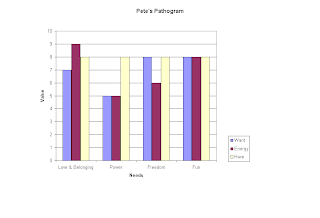
Once they had their graphs complete, we discussed them and applied them to their lives in school. It was during this discussion that we talked about nonnegotiable. Nonnegotiable are those rules that can't be broken. We all agreed that each and every classroom must be physically and emotionally safe and no one's individual need satisfaction could interfere with that. We also agreed that all students have the right to learn and again no one's individual need satisfaction could interfere with that.
The lesson today focused students attention on discovering how important the various need were in their lives. Each student was given a sheet of graph paper and asked to make a bar graph with a vertical axis from 1 to 10 and on the horizontal axis they were asked to write the needs (love & belonging, power, freedom, fun) down. Using three different colors and bars, they determined how much of each need they wanted (bar 1; color 1), how much energy they put into getting that need met (bar 2; color 2), and finally how much of that need they felt they actually had (bar 3; color 3). Their graphs looked something like the example below.

Once they had their graphs complete, we discussed them and applied them to their lives in school. It was during this discussion that we talked about nonnegotiable. Nonnegotiable are those rules that can't be broken. We all agreed that each and every classroom must be physically and emotionally safe and no one's individual need satisfaction could interfere with that. We also agreed that all students have the right to learn and again no one's individual need satisfaction could interfere with that.
This was a really good activity to get the students really thinking about their needs. The biggest problem I saw with the day was the length of time it took to get through it, but it was well worth it. As Vicki and I discussed the outcome of today's lesson, we agreed that loosing an entire class period to choice theory was sometimes necessary, however from this point forward we would spend Monday's on choice theory activities and Thursday's would be spent having short class meetings. I've already had a class meeting with my lit classes and it went really well. I will explain them more in my next post.
Subscribe to:
Posts (Atom)